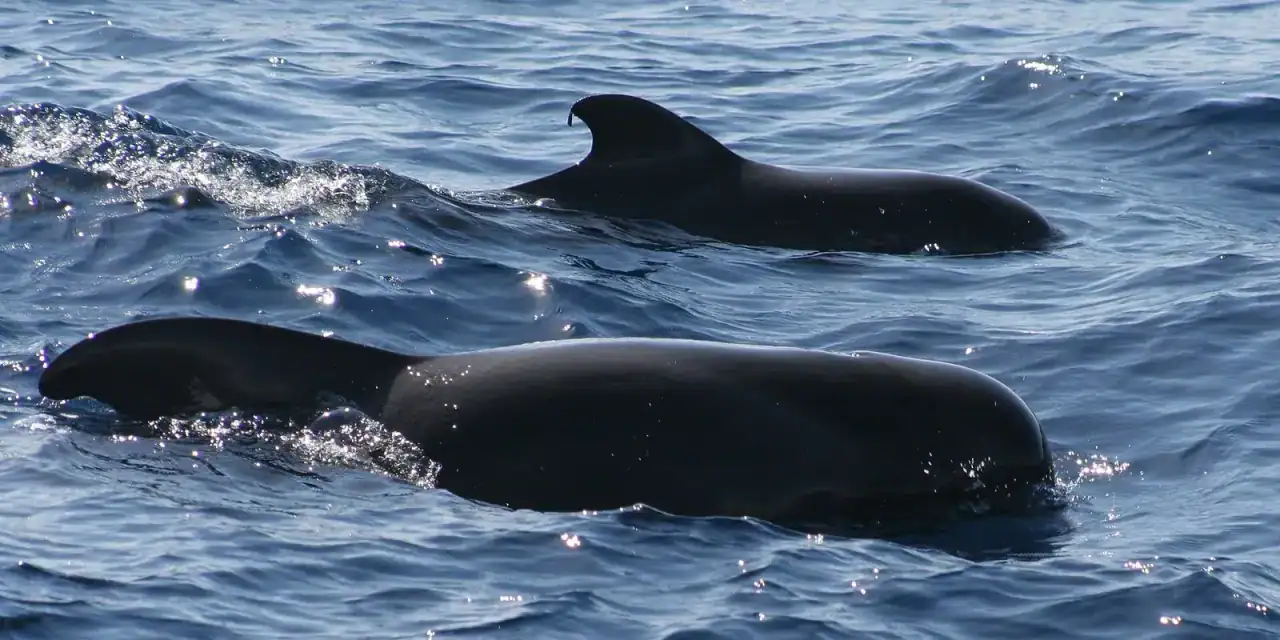
Whale watching in the Canary Islands has one clear centre: the sea off south-west Tenerife, in the stretch it shares with La Gomera. Short-finned pilot whales and bottlenose dolphins live there all year, and Tenerife has 113 of the archipelago's 184 licensed boats. If you only do one trip, go from Los Cristianos, Puerto Colón or Los Gigantes.
For a 10- or 12-seat boat and less traffic, look to Valle Gran Rey (La Gomera) or Tazacorte (La Palma). On Gran Canaria, Fuerteventura and Lanzarote the trips are mainly for dolphins: the animals are passing through, and no serious operator can promise you whales.
Where to see whales and dolphins in the Canaries
Los Cristianos, Puerto Colón, Los Gigantes
Resident pilot whales and bottlenose dolphins; 113 licensed boats and 1.5–2 h trips from €25 on the operator's website.
Valle Gran Rey
About 13 boats; 3–4 h trips with ten people at most, for €48; there is no resident group here.
Puerto de Tazacorte
The whole fleet, nine boats, in a single west-coast harbour; trips with biologists from €45–60.
Puerto Rico and Puerto de Mogán
About 17 boats, 14 of them in Puerto Rico; 2–2.5 h dolphin trips for €35–40.
Morro Jable
About 20 boats, 14 of them in Morro Jable; 2 h trips from €49.
Puerto Calero and Puerto del Carmen
Just five to seven boats; sunset cruises with dolphins from €52.
Why south-west Tenerife: the whales and dolphins that never leave
South-west Tenerife is the sheltered side of the island. The Teno-Rasca marine special area of conservation (Franja marina de Teno-Rasca, 69,489 ha, from Buenavista del Norte to Arona) lies in the lee of the trade winds, and the seabed drops beyond 500 m a short way off the coast. Calm water and deep water right by the harbour: that is why 90-minute trips work.
One independent estimate puts the sailing time to deep water at about 12 minutes from Los Cristianos, 9 from Los Gigantes and 36 from Puerto Colón. That is why the short trips from Puerto Colón tend to run a little longer.
Since January 2021 the waters west of Tenerife and La Gomera, some 2,000 km², have formed the Tenerife–La Gomera Whale Heritage Area, the first in Europe. It is awarded by the World Cetacean Alliance, a network of NGOs; if an advert calls it a "UNESCO sanctuary", that is wrong.
Around 30 cetacean species have been recorded in the Canaries, roughly a third of all those that exist, including six rorquals: minke, sei, Bryde's, fin, blue and humpback whales.
Whale watching season in the Canary Islands: what you can see each month
The two residents can be seen in any month; what changes is the visitors. The table follows Tenerife's tourist board (Turismo de Tenerife) classification for the channel between the two islands; there is no official calendar for the rest.
| Jan | Feb | Mar | Apr | May | Jun | Jul | Aug | Sep | Oct | Nov | Dec | |
|---|---|---|---|---|---|---|---|---|---|---|---|---|
| Pilot whale and bottlenose dolphin | ideal | ideal | ideal | ideal | ideal | ideal | ideal | ideal | ideal | ideal | ideal | ideal |
| Atlantic spotted dolphin | likely | likely | likely | likely | likely | unlikely | unlikely | unlikely | unlikely | likely | likely | likely |
| Common dolphin | likely | likely | unlikely | unlikely | unlikely | unlikely | unlikely | unlikely | unlikely | unlikely | unlikely | likely |
| Sperm whale | unlikely | unlikely | likely | likely | likely | unlikely | unlikely | unlikely | unlikely | unlikely | unlikely | unlikely |
| Variety of species | unlikely | unlikely | unlikely | unlikely | ideal | ideal | unlikely | unlikely | unlikely | unlikely | unlikely | unlikely |
unlikelylikelyideal
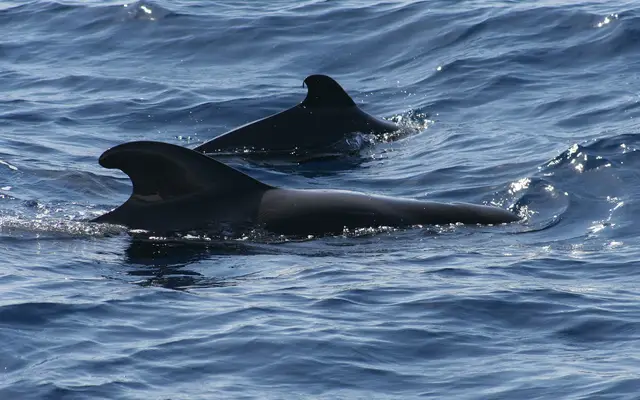
The short-finned pilot whale grows to more than 5 m and is "the easiest species to find"; bottlenose dolphins travel in groups of 10 to 30. Occasional sightings all year include Bryde's whale, the rough-toothed dolphin, the striped dolphin and Risso's dolphin. May and June are the best months for adding other species to the residents: if you can choose, see the Canary Islands in May.
Turismo de Tenerife reckons boats can go out eight days in ten and talks of a sighting rate "close to 100 %". Even so, no Tenerife operator offers a written guarantee with a refund.
Island by island: ports, fleet and prices
The official register of licensed boats says a lot about where it makes sense to book (approximate figures: the register has duplicate rows).
| Island | Licensed boats | Home ports |
|---|---|---|
| Tenerife | 113 | Puerto Colón 64, Los Gigantes 22, Los Cristianos 11, Las Galletas 9, others 5 |
| Fuerteventura | about 20 | Morro Jable 14, Corralejo 5, Caleta de Fuste 1 |
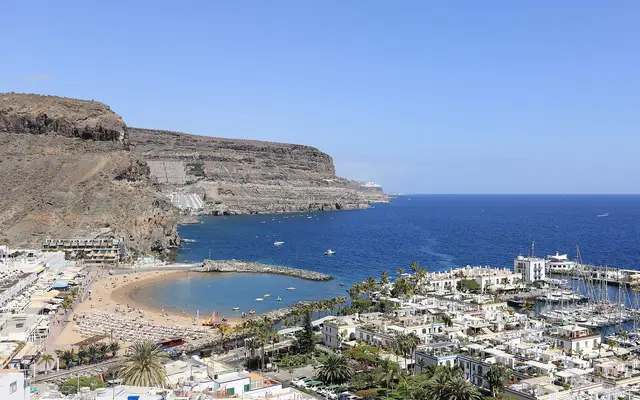
| Gran Canaria | about 17 | Puerto Rico 14, Puerto de Mogán 3 |
| La Gomera | about 13 | Valle Gran Rey 11, Playa Santiago 1, San Sebastián 1 |
| La Palma | 9 | Puerto de Tazacorte |
| Lanzarote | 5–7 | Puerto Calero, Puerto del Carmen |
| El Hierro | 2 | Puerto de La Estaca |
- 1Los CristianosportDirections ↗
- 2Puerto ColónportDirections ↗
- 3Los GigantesportDirections ↗
- 4Valle Gran ReyportDirections ↗
- 5Puerto de TazacorteportDirections ↗
- 6Puerto RicoportDirections ↗
- 7Puerto de MogánportDirections ↗
- 8Morro JableportDirections ↗
- 9Puerto CaleroportDirections ↗
Tenerife: Los Cristianos, Puerto Colón and Los Gigantes
The easiest and cheapest option. The two best-selling trips both leave from Los Cristianos and both last an hour and a half: Travelin' Lady (from €27.90 on its website, with a swim by Montaña de Guaza) and the "no-chase" glass-bottom catamaran trip, on which you cannot swim. Puerto Colón, in Costa Adeje, has the biggest fleet: large catamarans such as Freebird (2 h, €30) or Royal Delfin (2 h, €33), plus 3- and 4.5-hour trips with lunch.
Los Gigantes adds the cliffs, up to 600 m high, and a swim in a cove, sea permitting, in two hours (from €28). Arrive an hour early: parking at the harbour is tricky. Port-by-port comparison in whale and dolphin watching in Tenerife and company by company in Tenerife operators.
La Gomera: Valle Gran Rey
La Gomera shares the Whale Heritage Area with Tenerife, but the experience is different. Oceano Whale Watching La Gomera sails from Vueltas on a traditional fishing boat with ten people at most, for 3 to 4 hours with a guide, at €48 for adults and €32 for children up to 11. It publishes its sightings every fortnight, and its reports include minke whales, striped and rough-toothed dolphins, pilot whales and beaked whales. It warns that there is no resident group there, so nothing is guaranteed.
Excursiones Tina and Speedy, the other names you will see, currently have their boat trips suspended. Valle Gran Rey is 70 minutes by coastal boat from the ferry, so it suits a night on the island better than a day trip from Tenerife. More in our Oceano review and in the La Gomera guide.
La Palma: Puerto de Tazacorte
All nine La Palma boats sail from the same harbour on the west coast, the most sheltered side of the island. The island tourist board (Patronato de Turismo) puts the best area between Tazacorte and Puntagorda: dolphins, pilot whales and, now and then, Bryde's whales. OceanExplorer sails with marine biologists on the Flipper (a hundred seats, never filled beyond 70 %) and the twelve-seat Bussard, passing Porís de Candelaria and the new Tajogaite lava delta.
In the same harbour, Fancy II has a catamaran with underwater windows, a glass-bottom boat that goes into the Cueva Bonita sea cave and a sailing boat; on its website, trips start at €60 (2–2.5 h) and the sailing boat at about €74. On the booking platforms, the biologist-led tour costs from €60 and a 2 h coastal trip from €45. Details in whale watching in La Palma.
Gran Canaria: Puerto Rico and Puerto de Mogán
Puerto Rico is the island's base, with 14 boats; Pasito Blanco has none registered. The veteran is Spirit of the Sea, a catamaran with both hulls glazed: departures at 10:30 and 13:30, 2 h 30, free pick-up from hotels in the south. Its website does not publish a price; resellers sell it for about €40 for adults and €25 for children. Cheaper is the Líneas Salmón trip, 2 h for €35 (€25 for ages 6 to 12), advertised as "guaranteed sightings" without saying what happens if you are out of luck.
On the booking platforms there are trips from Puerto Rico from €38–40 and a 4-hour one from Puerto de Mogán from €80. It is a dolphin trip; whales, if they turn up, are a bonus. More in Puerto Rico and Mogán and in the Spirit of the Sea review.
Fuerteventura, Lanzarote and El Hierro
Fuerteventura has more licensed boats than La Gomera or La Palma, about 20, and 14 are in Morro Jable: 2 h trips with drinks and a swim from €49. If you are staying in the south, see Jandía and Cofete. Lanzarote has barely five to seven boats; what is sold there is sunset cruises with dolphins from €52, more a boat outing than a cetacean trip. On El Hierro the two registered boats belong to a dive centre: there, the sea is something you experience underwater.
The law: distances, time limits and why you cannot swim with dolphins
Every island follows Canary Islands Decree 178/2000 (Decreto 178/2000) and Spain's Royal Decree 1727/2007 (Real Decreto 1727/2007). Each boat needs a licence renewed every year, a specialist guide on board and the Barco Azul flag: yellow, 80 × 50 cm, with two white pilot whales and, below them, the licence period in blue figures. The Canary rules prohibit:
- Approaching closer than 60 m, or approaching head-on, from behind or at right angles.
- Sailing faster than 4 knots within 500 m, or chasing, encircling or feeding the animals.
- Spending more than 30 minutes within 100 m, or entering those 100 m if two boats are already there.
- Swimming or diving within 500 m of cetaceans, or watching them from a jet ski.
"No-chase", "eco" or "responsible" are not official categories: chasing is banned for everyone. And "Blue Flag" in a whale-watching advert is a mistranslation of Barco Azul ("blue boat"), the compulsory licence. The rules are on the Canary Islands Government cetacean-watching page and the Spanish decree in the BOE, Spain's official gazette. Going it alone is not an option either: you can no longer hire a boat without a boating licence anywhere in Spain.
How to choose a responsible boat (and not get seasick)
All legal boats follow the same rules; what changes is size, time on the water and distance from the animals. Before you pay:
- Look the boat up in the register. It is on the Canary Islands Government open-data portal, with name, port and a code CT-38-4-… It takes a minute.
- Check the yellow flag. It should show the current period; a faded flag with an old year is a bad sign.
- Choose your size. In Tenerife there is everything from six-seat speedboats to catamarans carrying around a hundred. Fewer people means more room at the rail, not more animals.
- Ask how long you will spend with the animals. The legal maximum is half an hour within 100 m; some operators limit it to 15 minutes.
- In Tenerife, look for the Sustainability Charter. It is voluntary, and Turismo de Tenerife assesses its signatories every year.
On seasickness: south-west Tenerife lies in the lee of the prevailing wind, and La Palma's west coast is the most sheltered on the island. For the other islands there is no official data by coast; ask the operator about sea conditions. One sailing boat in Puerto Colón warns that it is not suitable for anyone prone to seasickness. Bring seasickness tablets, sun cream, binoculars and a warm layer: it feels cooler out at sea.
Our picks, island by island
See the short trip from Los Cristianosfrom €28Affiliate link: it costs you nothing extra.
Our pick
1
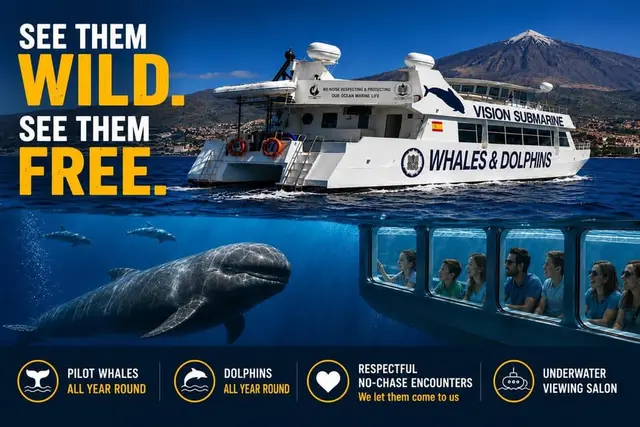
Tenerife, the short trip
An hour and a half from Los Cristianos, by the pilot whale colony; glass-bottom catamaran and no swim, for those who just want to see the animals.
GetYourGuide1.5 hours
Tenerife: Eco No-Chase Respectful Whale & Dolphin Encounter
4.6 (15,400 reviews)
from €28Check availability
2
Tenerife, cliffs and a swim
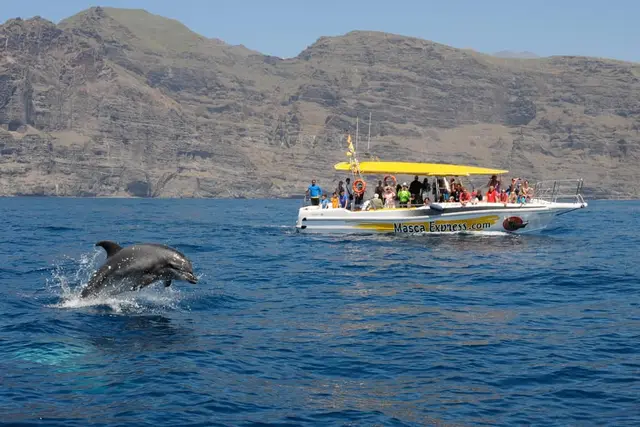
Two hours from Los Gigantes with the cliffs and a swim stop in a cove; arrive in good time to park.
GetYourGuide2 hours
Los Gigantes: Dolphin & Whale Watching Cruise with Swim Stop
4.7 (5,807 reviews)
from €28Check availability
3
La Palma, with a marine biologist
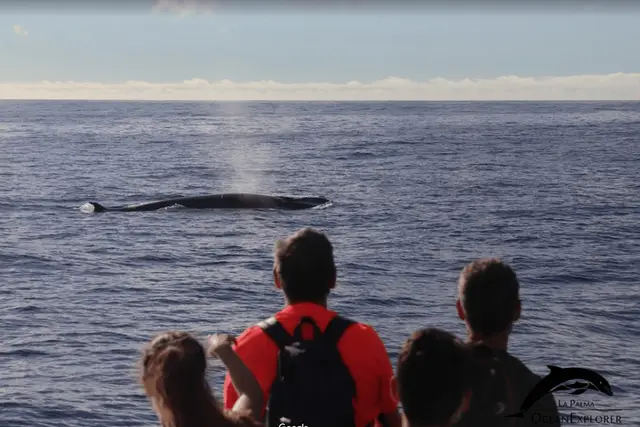
Three hours from Tazacorte along the west coast, with fewer boats around and commentary on what you are seeing.
GetYourGuide3 hours
La Palma: Whale & Dolphin Tour with Marine Biologist
4.5 (1,166 reviews)
from €60Check availability
4
Gran Canaria, from Puerto Rico
The island's base with the most boats; a dolphin outing for anyone staying in the south.
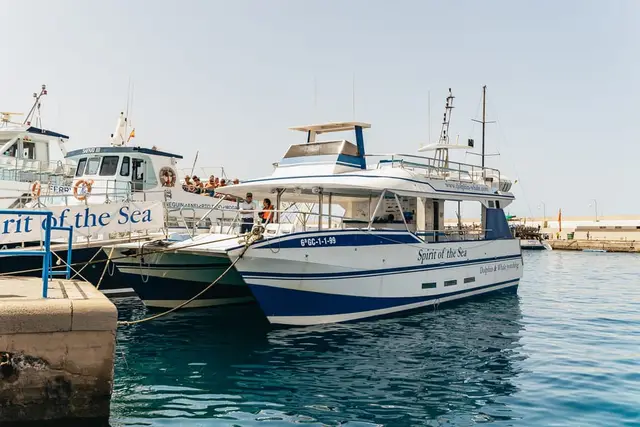
GetYourGuide2.5 hours
From Puerto Rico de Gran Canaria: Dolphin-Watching Cruise
4.3 (2,717 reviews)
from €40Check availability
5
Fuerteventura, Morro Jable
The harbour with the most boats on the island; two hours with drinks and a swim.
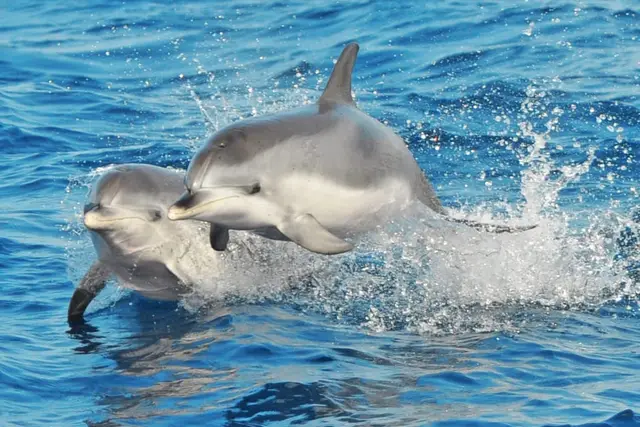
GetYourGuide2 hours
Morro Jable: Dolphin & Whale-Watching Cruise, Drinks & Swim
4.2 (5,394 reviews)
from €49Check availability
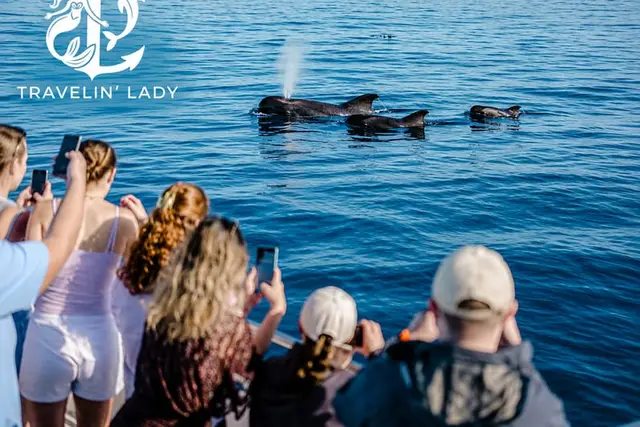
GetYourGuide1.5 hours
Travelin' Lady: Eco Yacht Whale & Dolphin Safari + Swim
4.7 (19,421 reviews)
from €29.90Check availability
GetYourGuide1.5 hours
Tenerife: Eco No-Chase Respectful Whale & Dolphin Encounter
4.6 (15,400 reviews)
from €28Check availability
GetYourGuide2 hours
Los Gigantes: Dolphin & Whale Watching Cruise with Swim Stop
4.7 (5,807 reviews)
from €28Check availability
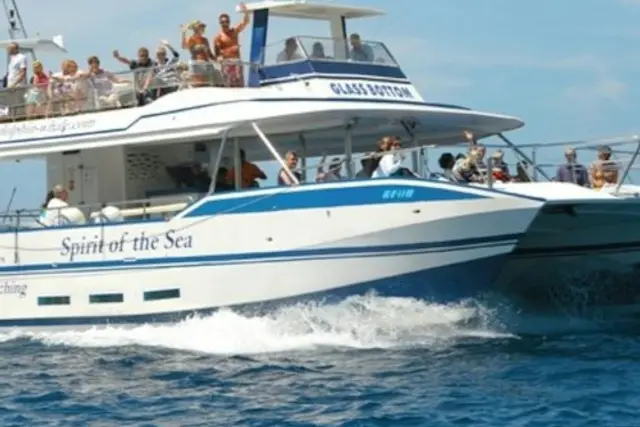
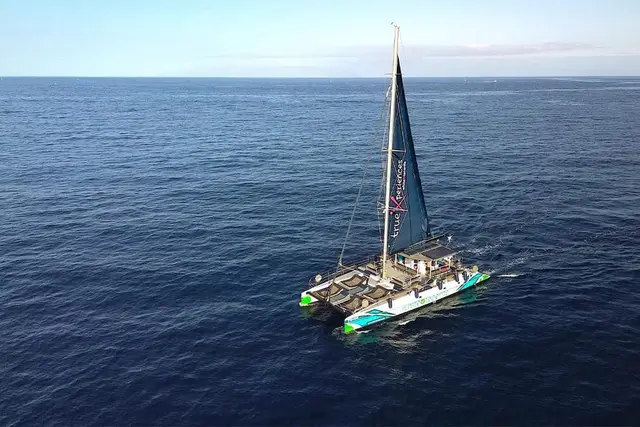
GetYourGuide3 - 5 hours
Costa Adeje: Whale & Dolphin Eco-Cruise with Snacks & Drinks
4.6 (5,829 reviews)
from €47Check availability
GetYourGuide3 hours
La Palma: Whale & Dolphin Tour with Marine Biologist
4.5 (1,166 reviews)
from €60Check availability
See all options on GetYourGuide →Prices checked on 2 October 2026
Frequently asked questions
Where can you see dolphins in the Canary Islands?
The most reliable spot is south-west Tenerife (Los Cristianos, Puerto Colón, Los Gigantes), with bottlenose dolphins and pilot whales all year. There are also trips from Valle Gran Rey, Tazacorte, Puerto Rico on Gran Canaria and Morro Jable.
What is the best time for whale watching in the Canary Islands?
Any month works for the resident pilot whales of Tenerife and La Gomera. For more species, go in May and June; sperm whales are seen more in spring and common dolphins in winter.
Can you swim with dolphins in the Canary Islands?
No. Swimming or diving within 500 m of wild cetaceans is prohibited. Swim stops take place away from the animals.
How much does dolphin watching cost in the Canary Islands?
In Tenerife, a 1.5–2 h trip costs €25–33 booked direct and from €28 on the booking platforms. On Gran Canaria and Fuerteventura, 2–2.5 h trips cost around €35–50; on La Gomera, €48.
Can you see whales in Gran Canaria?
Sometimes, but the trip from Puerto Rico is mainly about dolphins; Spirit of the Sea lists the short-finned pilot whale and the humpback among its species. There are no resident groups as in Tenerife, and what turns up depends on the animals passing through.
What happens if we don't see any animals?
We cannot promise sightings, and in Tenerife no operator gives a written guarantee with a refund. On Gran Canaria, according to resellers, Spirit of the Sea gives you a voucher to go again free within a year; it is not on its website, so ask before you book.