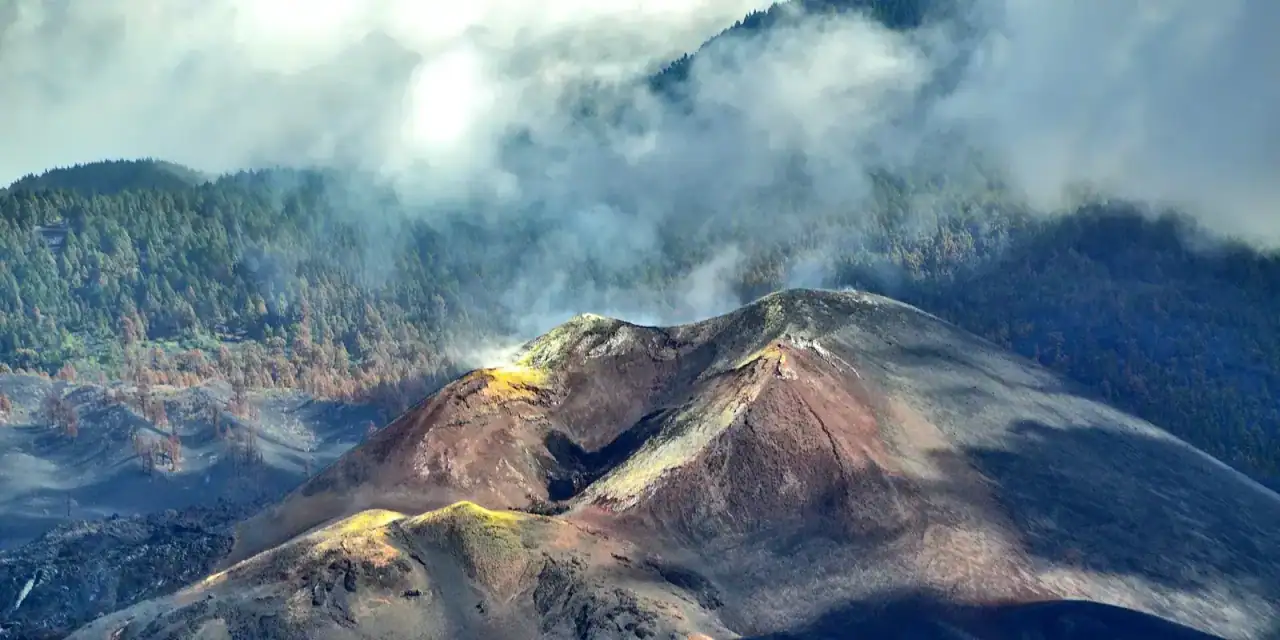
A visit to the Tajogaite volcano works on two levels. You can only set foot on the cone and the ash field with a guide, on the trail opened by the Cabildo (the island council). Everything else (viewpoints, the road over the lava, the lava deltas seen from the harbour) is free and needs no booking.
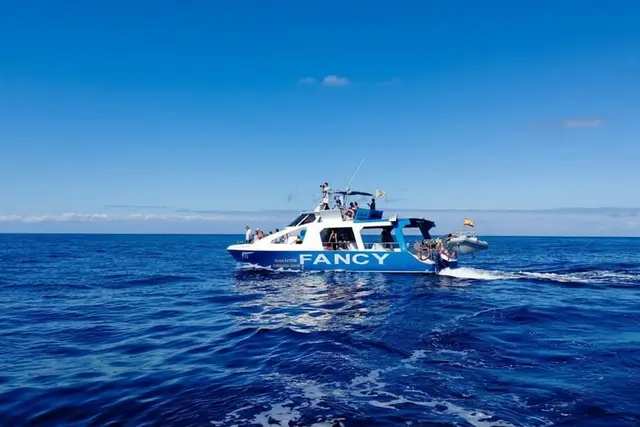
Our advice: a guided hike with a local company and, on the same day, the El Paso viewpoints and Caños de Fuego. If you don't walk, the boat from Tazacorte shows you the lava that reached the sea.
Can you visit the La Palma volcano? What's allowed today
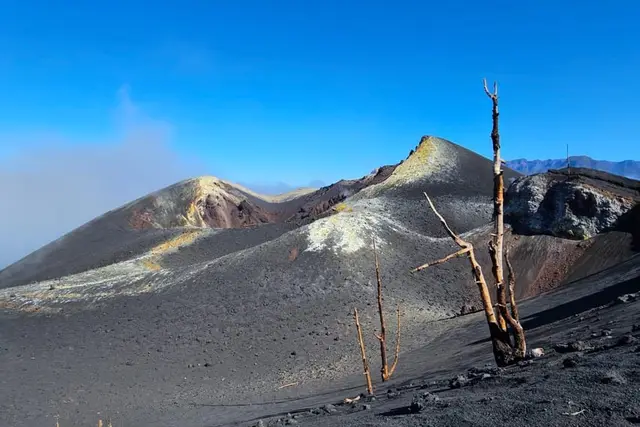
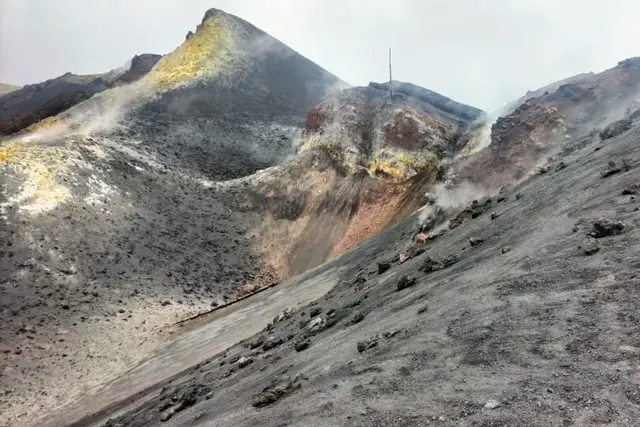
The official sheet for the trail "por el nuevo volcán Tajogaite" (along the new Tajogaite volcano) is unambiguous: you need a permit and the booking is "only with an authorised company". The route ends at a safe distance from the cone; you don't climb to the crater rim.
The name is official too. "Cumbre Vieja" is the ridge and the natural park; the 2021 volcano is called Volcán de Tajogaite by decision of the full Cabildo council, after a non-binding public vote in which that name won 59.3% of the votes.
Tajogaite volcano guided hike: route, duration and price
What the route is like
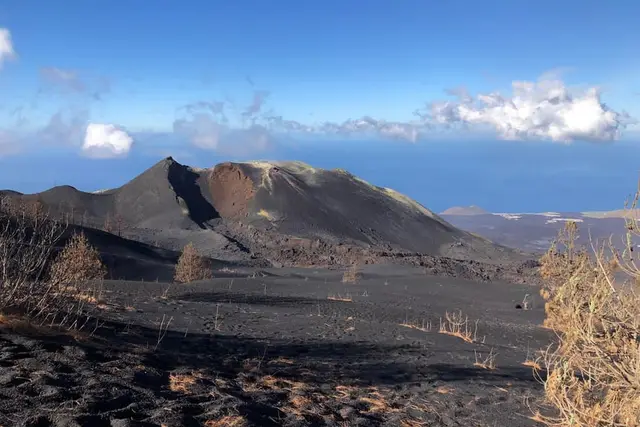
It starts at Llano del Jable, high above El Paso, and partly follows the Cabeza de Vaca path to a point close to the cone. The official sheet (visitlapalma.es) gives about 6 km as a loop, "just over two hours" and easy difficulty; the companies' variants range from about 5 to 7.4 km. The guides were trained by scientists from IGME-CSIC and groups are small. Companies meet you in El Paso or Las Manchas and take you to the trailhead. The ground is volcanic sand: wear walking boots and bring water and sun cream.
Price: direct or through a platform
Each company's prices at the time of writing:
| Company (own website) | Price | Details |
|---|---|---|
| Astronorte | €32 | 2 h 50 min |
| Senderismo La Palma (via AstroLaPalma) | €32 adult, €16 child | 2.5 h, 7.38 km; leaves from Caños de Fuego with transfer |
| Isla Bonita Tours | €30 in your own car, €45 with pick-up | — |
| La Palma Outdoor | €38, Canary Islands residents €33, children €20 | — |
| La Palma Transfer & Tours | €35, €48 with coach | — |
On GetYourGuide the hike costs €32 to €55 depending on length and pick-up; on the 8-hour versions, the walk by the cone is still two or three hours. If you have a car, booking directly with a local company usually works out the same or cheaper.
Many departures are in Spanish only (Astronorte and Senderismo La Palma say so): if you need English or another language, ask before paying. There is no public list of authorised companies, so ask yours whether it runs the official trail.
Our pick
1
The official route with a local guide
Certified guide and one of the best rated.
GetYourGuide4 hours
Tajogaite Volcano: the official route with a certified local guide
4.9 (545 reviews)
from €37Check availability
2
Short version, 5 km
For children or tired legs: the same landscape, less distance.
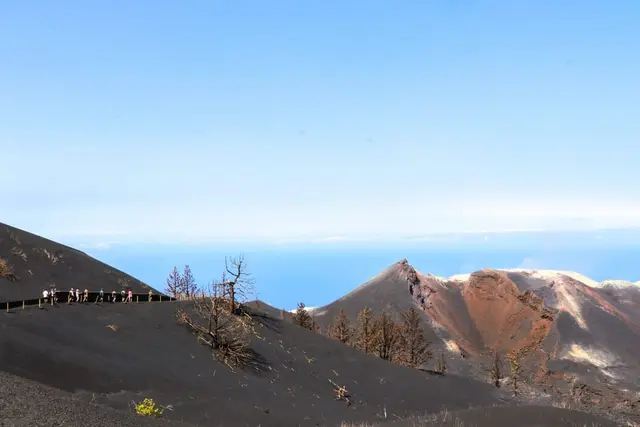
GetYourGuide3 hours
Tajogaite Volcano, the essential route: 5 km short version
4.8 (82 reviews)
from €35Check availability
3
The most booked
Over two thousand reviews and four hours in total.
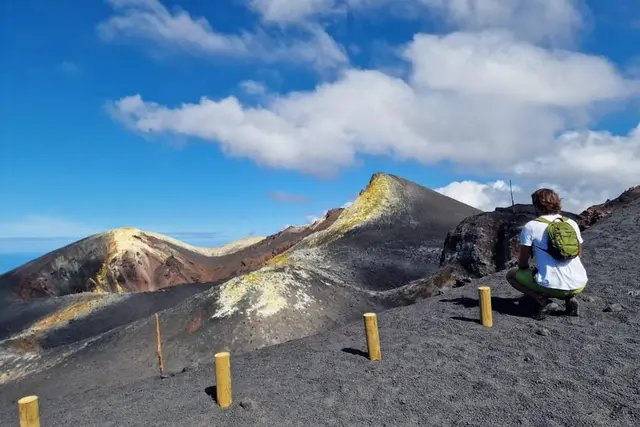
GetYourGuide4 hours
La Palma: Tajogaite Volcano Guided Trek
4.8 (2,198 reviews)
from €38Check availability
4
Inside the Cueva de Las Palomas
A 1949 lava tube with helmet and lamp; a good add-on the same day.
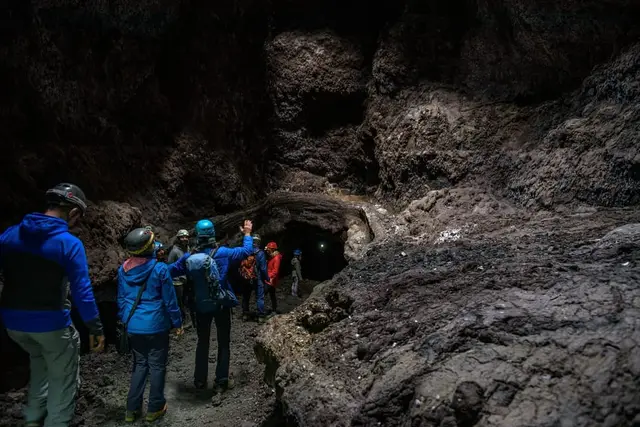
GetYourGuide2 hours
La Palma: Cueva de Las Palomas Volcanic Tube
4.7 (696 reviews)
from €25Check availability
5
The volcano from the sea
A boat from Tazacorte along the Cumbre Vieja coast; check the listing to see if it passes the lava deltas.
GetYourGuide2.5 hours
La Palma: Wildlife Viewing and Cumbre Vieja Boat Tour
4.5 (300 reviews)
from €61.20Check availability
Visiting on your own: Tajogaite viewpoints you can reach by yourself
The Cabildo designated these spots as safe for viewing the eruption:
- Monument to the Virgen de Fátima (Las Manchas): lava flows from 2021 and from the San Juan eruption of 1949.
- Tajuya church (El Paso): the press viewpoint during the eruption and the easiest without a car (bus 300, stops "Iglesia Tajuya" and "Cruce Tajuya").
- Camino de Los Campitos (Los Llanos de Aridane), walking up from the Museo Benahoarita.
- Puerto de Tazacorte: the best place to see the lava deltas that created new land from the sea; the cone is a long way off.
- Mirador de El Time, which the island's official guide adds to the list.
The coast road between Tazacorte and Puerto Naos crosses the lava for 2.4 km: it's the only stretch where you drive over the 2021 flows.
- 1Volcán TajogaitepeakDirections ↗
- 2Llano del JablesightDirections ↗
- 3Mirador de TajuyasightDirections ↗
- 4Caños de FuegosightDirections ↗
- 5El PasotownDirections ↗
- 6Los Llanos de AridanetownDirections ↗
- 7Puerto de TazacorteportDirections ↗
- 8Puerto NaosbeachDirections ↗
- 9Mirador de El TimesightDirections ↗
Caños de Fuego and the Cueva de Las Palomas: the lava of 1949
Caños de Fuego and the Cueva de Las Palomas are not part of Tajogaite. They are lava tubes from the San Juan eruption of 1949, in Las Manchas, a few minutes from the new volcano, even though many websites mix them up.
The Cabildo's interpretation centre has an exhibition, a film and a guided visit of about 15 minutes to the "Cueva de Vidrio" tube. It opens daily from 10:00 to 18:00 and costs €8 (reduced €4, under-12s free). If you only want the walkways over the lava and the glass viewpoint at the mouth of the Cueva de Las Palomas, entry is €4 (about 30 minutes; last entry 17:45). Card only; more at lapalmacentrosturisticos.com.
Going inside the Cueva de Las Palomas is a different matter: only with an authorised company and advance booking, a maximum of 14 people plus the guide, a 90-minute trip with about 20 minutes inside the tube, helmet with lamp included. Ages 5 to 75, in closed shoes; not suitable if you're claustrophobic or have mobility problems.
Volcano trips by boat or buggy
- By boat: boats leave Puerto de Tazacorte and skirt the new lava deltas (Fancy II with its "Tajogaite from the sea" trip, and OceanExplorer's Flipper, which passes the Fajana Nueva). Each boat is covered in whale watching in La Palma.
- By buggy: the volcano route of about 5 hours leaves from El Llanito and follows forest tracks on Cumbre Vieja, near Tajogaite, to San Antonio and Teneguía. You pay per vehicle (from €179 for a two-seater on the operator's website). It doesn't go onto the cone or the lava flow.
The Tajogaite eruption in numbers
- Start: 19 September 2021, at Cabeza de Vaca, Las Manchas (El Paso).
- End: activity stopped on 13 December and the eruption was declared over on 25 December: 85 days and 8 hours, the longest recorded on La Palma (the Tajuya eruption of 1585 lasted 84).
- Lava: 1,219 hectares covered, with flows more than 6 km long.
- New land: two lava deltas, about 48 ha gained from the sea. The "27 hectares" still quoted date from the first few weeks.
- Damage: about 7,000 people evacuated, 2,988 buildings destroyed according to Copernicus and €842 million in losses.
The island's official guide calls it Spain's youngest volcano, but it isn't the only recent eruption in the Canaries: on El Hierro, Tagoro (2011–2012) was underwater. Teide and Timanfaya are in volcanoes of the Canary Islands.
Respect in Puerto Naos, La Bombilla and the affected neighbourhoods
Homes and farms lie under the lava. The Cabildo asks for visits that are "respectful and in appropriate places": stay on roads, viewpoints and the guided trail, don't take stones or build little cairns, and don't go onto property even if it looks abandoned.
From El Paso you're close to the Caldera de Taburiente and the southern volcanoes (in the La Palma guide); more routes in hiking in the Canary Islands. Llano del Jable, where this route starts, is also an astronomical viewpoint: for the night, see the Roque de los Muchachos guide.
GetYourGuide4 hours
La Palma: Tajogaite Volcano Guided Trek
4.8 (2,198 reviews)
from €38Check availability
GetYourGuide2 hours
La Palma: Cueva de Las Palomas Volcanic Tube
4.7 (696 reviews)
from €25Check availability
GetYourGuide4 hours
Tajogaite Volcano: the official route with a certified local guide
4.9 (545 reviews)
from €37Check availability
GetYourGuide3 hours
La Palma: 360° tour of the new Tajogaite volcano
4.8 (336 reviews)
from €40Check availability
GetYourGuide3.5 hours
La Palma: Tajogaite Volcano Guided Hike
4.8 (309 reviews)
from €55Check availability
GetYourGuide8 hours
La Palma: Guided Tour to Tajogaite Volcano with Transfer
4.8 (213 reviews)
from €48Check availability
See all options on GetYourGuide →Prices checked on 2 October 2026
Can you visit the Tajogaite volcano on your own?
Not the cone: the official trail requires you to go with an authorised company. On your own you can see the lava from the viewpoints at Las Manchas, Tajuya and Puerto de Tazacorte, and drive across it on the coast road.
How much does a guided Tajogaite volcano tour cost?
Direct with the local companies, about €30 to €48 per adult depending on whether pick-up is included; on GetYourGuide, from €32.
How long is the Tajogaite volcano hike?
The official circuit is about 6 km and takes just over two hours to walk; with the transfer from the meeting point, allow 2.5 to 4 hours.
Are Tajogaite volcano tours in English?
Many departures are in Spanish only. If you need English or another language, confirm with the company before paying.
Is the Cueva de Las Palomas from the 2021 volcano?
No. The Cueva de Las Palomas and Caños de Fuego are lava tubes from the San Juan eruption of 1949.